
Cole Porter – The Great American Songbook
This is one of a five-part investigation of the major writers of the Great American Songbook:
- Jerome Kern (1885-1945)
- Irving Berlin (1888 – 1989)
- Richard Rodgers (1902-1979)
- George Gershwin (1898-1937)
And tonight we look at — a sampling of — the music of Cole Porter (we could — and should — be here all night really!).
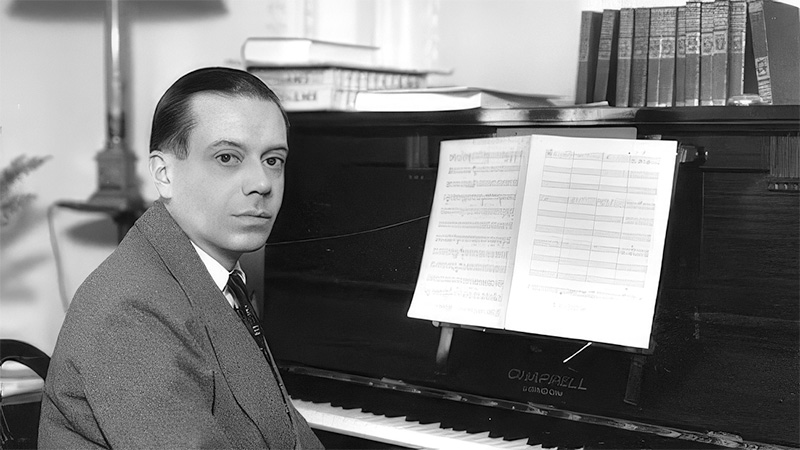
Cole Albert Porter (June 9, 1891 – October 15, 1964) was an American composer and songwriter. Many of his songs became standards noted for their witty, urbane lyrics, and many of his scores found success on Broadway and in film. Born to a wealthy family in Indiana, Porter defied his grandfather’s wishes and took up music as a profession. Classically trained, he was drawn to musical theatre. After a slow start, he began to achieve success in the 1920s, and by the 1930s he was one of the major songwriters for the Broadway musical stage. Unlike many successful Broadway composers, Porter wrote the lyrics as well as the music for his songs. After a serious horseback riding accident in 1937, Porter was left disabled and in constant pain, but he continued to work. His shows of the early 1940s did not contain the lasting hits of his best work of the 1920s and 1930s, but in 1948 he made a triumphant comeback with his most successful musical, Kiss Me Kate. It won the first Tony Award for Best Musical.
Porter’s other musicals include Fifty Million Frenchmen, DuBarry Was a Lady, Anything Goes Can-Can and Silk Stockings (we’ll hear from those ones in a moment). His numerous hit songs include “Night and Day” (perhaps Porter’s most popular contribution to the Great American songbook — it was introduced on stage by Fred Astaire, and has been recorded by dozens of musicians), “Begin the Beguine” (by the way, which Musicologist and composer Alec Wilder described it in his book American Popular Song: The Great Innovators 1900–1950 as “a maverick, an unprecedented experiment and one which, to this day, after hearing it hundreds of times, I cannot sing or whistle or play from start to finish without the printed music … about the sixtieth measure I find myself muttering another title, End the Beguine), “I Get a Kick Out of You”, “Well, Did You Evah!”, “I’ve Got You Under My Skin”, “My Heart Belongs to Daddy”, and “You’re the Top”. He also composed scores for films from the 1930s to the 1950s, including Born to Dance (1936), Rosalie (1937), High Society (1956), and Les Girls (1957).
I’m going to tell you about his life beginning in just a moment, but first…
Early years
Porter was born in Peru, Indiana, the only surviving child of a wealthy family. His father, Samuel Fenwick Porter, was a pharmacist by trade. His mother, Kate, was the indulged daughter of James Omar “J. O.” Cole, “the richest man in Indiana”, a coal and timber speculator who dominated the family. J. O. Cole built the couple a house on his Peru-area property, known as Westleigh Farms. After high school, Porter returned to his childhood home only for occasional visits.
Porter’s strong-willed mother doted on him and began his musical training at an early age. He learned the violin at age six, the piano at eight, and wrote his first operetta (with help from his mother) at ten. She falsified his recorded birth year, changing it from 1891 to 1893 to make him appear more precocious. His father, a shy and unassertive man, played a lesser role in Porter’s upbringing, although as an amateur poet, he may have influenced his son’s gifts for rhyme and meter. Porter’s father was also a talented singer and pianist, but the father-son relationship was not close.
Porter as a Yale College student
J. O. Cole wanted his grandson to become a lawyer, and with that in mind, sent him to Worcester Academy in Massachusetts in 1905. Porter brought an upright piano with him to school and found that music, and his ability to entertain, made it easy for him to make friends. Porter did well in school and rarely came home to visit. He became class valedictorian and was rewarded by his grandfather with a tour of France, Switzerland, and Germany.
Entering Yale College in 1909, Porter majored in English, minored in music, also studied French, and contributed to campus humour magazine The Yale Record. He was an early member of the Whiffenpoofs a cappella singing group and participated in several other music clubs; in his senior year, he was elected president of the Yale Glee Club and was its principal soloist.
Porter wrote 300 songs while at Yale, including student songs such as the football fight songs “Bulldog” and “Bingo Eli Yale” (aka “Bingo, That’s The Lingo!”) that are apparently still played at Yale. During college, Porter became acquainted with New York City’s vibrant nightlife, taking the train there for dinner, theatre, and nights on the town with his classmates, before returning to New Haven, Connecticut, early in the morning. He also wrote musical comedy scores for his fraternity, the Yale Dramatic Association, and as a student at Harvard – Cora (1911), And the Villain Still Pursued Her (1912), The Pot of Gold (1912), The Kaleidoscope (1913), and Paranoia (1914) — which helped prepare him for a career as a Broadway and Hollywood composer and lyricist.
After graduating from Yale, Porter enrolled in Harvard Law School in 1913, where incidentally, he roomed with future Secretary of State Dean Acheson. He soon felt that he was not destined to be a lawyer, and, at the suggestion of the dean of the law school, switched to Harvard’s music department, where he studied harmony and counterpoint. His mother did not object to this move, but it was kept secret from his grandfather.
In 1915, Porter’s first song on Broadway, “Esmeralda”, appeared in the revue Hands Up. This quick success was immediately followed by failure: his first Broadway production, in 1916, See America First, a “patriotic comic opera” modelled on Gilbert and Sullivan with a book by T. Lawrason Riggs was a flop, closing after two weeks. Porter spent the next year in New York City before going overseas during World War I.
Paris and marriage
In 1917, when the United States entered World War I Porter moved to Paris to work with the Duryea Relief organization. The French Foreign Legion lists Porter as one of its soldiers and displays his portrait at its museum in Aubagne (small city in southern France). By some accounts, he served in North Africa and was transferred to the French Officers School at Fontainebleau, teaching gunnery to American soldiers. An obituary notice in The New York Times stated that, while in the Legion, “he had a specially constructed portable piano made for him so that he could carry it on his back and entertain the troops in their bivouacs.”
Porter maintained a luxury apartment in Paris, where he entertained lavishly. His parties were extravagant and scandalous, with “much gay and bisexual activity, Italian nobility, cross-dressing, international musicians, and a large surplus of recreational drugs”. In 1918, he met Linda Lee Thomas, a rich, Louisville, Kentucky-born divorcée eight years his senior. She was beautiful and well-connected socially; the couple shared mutual interests, including a love of travel, and she became Porter’s confidante and companion. The couple married the following year. She was in no doubt about Porter’s homosexuality, but it was mutually advantageous for them to marry. For Linda, it offered continued social status and a partner who was the antithesis of her abusive first husband. For Porter, it brought a respectable heterosexual front in an era when homosexuality was not publicly acknowledged. They were, moreover, genuinely devoted to each other and remained married from December 19, 1919, until her death in 1954.
Marriage did not diminish Porter’s taste for extravagant luxury. The Porter home on the rue Monsieur near Les Invalides (7ieme arrondissement) was a palatial house with platinum wallpaper and chairs upholstered in zebra skin. In 1923, Porter came into an inheritance from his grandfather, and the Porters began living in rented palaces in Venice. He once hired the entire Ballets Russes to entertain his guests, and for a party at Ca’ Rezzonico, which he rented for $4,000 a month ($64,000 in current value), he hired 50 gondoliers to act as footmen and had a troupe of tightrope walkers perform in a blaze of lights. In the midst of this extravagant lifestyle, Porter continued to write songs with his wife’s encouragement.
Porter received few commissions for songs in the years immediately after his marriage. But in 1923 he composed a short ballet, originally titled Landed and then Within the Quota, satirically depicting the adventures of an immigrant to America who becomes a film star. The work lasts about sixteen minutes, was orchestrated by Charles Koechlin and shared the same opening night as Milhaud’s La creation du monde. Porter’s work was one of the earliest symphonic jazz-based compositions, predating George Gershwin’s Rhapsody in Blue by four months, and was well received by both French and American reviewers after its premiere at the Théâtre des Champs-Élysées in October 1923. Frustrated by the public response to most of his work, Porter nearly gave up songwriting as a career, although he continued to compose songs for friends and perform at private parties.
Broadway and London West End success
At the age of 36, Porter reintroduced himself to Broadway in 1928 with the musical Paris his first hit. The commissioner had wanted Rodgers and Hart to write the songs, but they were unavailable, and Porter’s agent persuaded Goetz to hire Porter instead. In August 1928, Porter’s work on the show was interrupted by the death of his father. He hurried back to Indiana to comfort his mother before returning to work. The songs for the show included “Let’s Misbehave” and one of his best-known list songs, “Let’s Do It, Let’s Fall In Love.” The show opened on Broadway on October 8, 1928. In biographer Citron’s phrase, Porter was finally “accepted into the upper echelon of Broadway songwriters.” C.B. Cochran now wanted more from Porter than isolated extra songs; he planned a West End extravaganza similar to Florenz Ziegfeld’s shows, with a Porter score and a large international cast. The revue, Wake Up and Dream, ran for 263 performances in London, after which Cochran transferred it to New York in 1929. On Broadway, business was badly affected by the 1929 Wall Street crash, and the production ran for only 136 performances. From Porter’s point of view, it was nonetheless a success, as his song “What Is This Thing Called Love?” became immensely popular.
Porter’s new fame brought him offers from Hollywood, but because his score for Paramount’s The Battle of Paris was undistinguished, and its star, Gertrude Lawrence, was miscast, the film was not a success. Citron expresses the view that Porter was not interested in cinema and “noticeably wrote down for the movies.” Still on a Gallic (French) theme, Porter’s last Broadway show of the 1920s was Fifty Million Frenchmen (1929), for which he wrote 28 numbers, including “You Do Something to Me”. The show received mixed notices. As it was a lavish and expensive production, nothing less than full houses would suffice, and after only three weeks, the producers announced that they would close it. However, Irving Berlin, who admired and championed Porter, took out a paid press advertisement calling the show “The best musical comedy I’ve heard in years. … One of the best collections of song numbers I have ever listened to”. This saved the show, which ran for 254 performances, considered a successful run at the time.
1930s
Ray Goetz, producer of Paris and Fifty Million Frenchmen, the success of which had kept him solvent when other producers were bankrupted by the post-crash slump in Broadway business, invited Porter to write a musical show about the other city that he knew and loved: New York. The New Yorkers (1930) acquired instant notoriety for including a song about a streetwalker, “Love for Sale”. The lyric was considered too explicit for radio at the time, though it was recorded and aired as an instrumental and rapidly became a standard. Porter often referred to it as his favourite of his songs.
Next came Fred Astaire’s last stage show, Gay Divorce (1932). It featured a hit that became Porter’s best-known song, “Night and Day”. Despite mixed press (some critics were reluctant to accept Astaire without his previous partner, his sister Adele, the show ran for a profitable 248 performances, and the rights to the film, retitled The Gay Divorcee, were sold to RKO Pictures.
In 1934, producer Vinton Freedley — instead of commissioning book, music, and lyrics and then casting the show, Freedley sought to create an ideal musical with stars and writers all engaged from the outset. The stars he wanted were Ethel Merman, William Gaxton, and comedian Victor Moore. He planned a story about a shipwreck and a desert island. For the songs, he decided on Porter. The show, Anything Goes, was an immediate hit. Porter wrote what many consider his greatest score of this period. Porter subsequently called it one of his two perfect shows, along with the later Kiss Me Kate. The show ran for 420 performances in New York (a particularly long run in the 1930s) and 261 in London.
Anything Goes was the first of five Porter shows featuring Merman. He loved her loud, brassy voice and wrote many numbers that displayed her strengths. Jubilee (1935), written with Moss Hart while on a cruise around the world, was not a major hit, running for only 169 performances, but it featured two songs that have since become standards, “Begin the Beguine” and “Just One of Those Things”. Red, Hot and Blue (1936), featuring Merman, Jimmy Durante, and Bob Hope ran for 183 performances and introduced “It’s De-Lovely” among others. The relative failure of these shows convinced Porter that his songs did not appeal to a broad enough audience. In an interview, he said “Sophisticated allusions are good for about six weeks … more fun, but only for myself and about eighteen other people, all of whom are first-nighters anyway. Polished, urbane, and adult playwriting in the musical field is strictly a creative luxury.”
Porter also wrote for Hollywood in the mid-1930s. His scores include those for the MGM films Born to Dance (1936), with James Stewart featuring “You’d Be So Easy to Love” and “I’ve Got You Under My Skin”, and Rosalie (1937), featuring “In the Still of the Night”. Porter also composed the cowboy song “Don’t Fence Me In” for Adios, Argentina, an unproduced movie, in 1934, but it did not become a hit until Roy Rogers sang it in the 1944 film Hollywood Canteen. Bing Crosby, The Andrews Sisters. and others also popularized it in the 1940s.
The Porters moved to Hollywood in December 1935, but Porter’s wife did not like the movie environment, and Porter’s closeted homosexual acts, formerly very discreet, became less so; she retreated to their Paris house. When his film assignment on Rosalie was finished in 1937, Porter hastened to Paris to make peace with Linda, but she remained cool. Porter returned to New York in October 1937 without her. They were soon reunited by an accident Porter suffered.
On October 24, 1937, Porter was riding with friends at Piping Rock Club in Locust Valley, New York, when his horse rolled on him and crushed his legs, leaving him substantially crippled and in constant pain for the rest of his life. Though doctors told Porter’s wife and mother that his right leg would have to be amputated, and possibly the left one as well, he refused to have the procedure. Linda rushed from Paris to be with him and supported him in his refusal of amputation. He remained in the hospital for seven months before being allowed to go home to his apartment at the Waldorf Towers. He resumed work as soon as he could, finding it took his mind off his constant pain.
Porter’s first show after his accident was not a success. You Never Know (1938) ran for only 78 performances. The score included the songs “From Alpha to Omega” and “At Long Last Love”. He returned to success with Leave It to Me! (1938); the show introduced Mary Martin, singing “My Heart Belongs to Daddy” among others. Porter’s last show of the 1930s was DuBarry Was a Lady (1939), a particularly risqué show starring Merman and Bert Lahr (cowardly lion of Wizard of Oz). After a pre-Broadway tour, during which it ran into trouble with Boston censors, however it achieved 408 performances. At the end of 1939, Porter contributed six songs to the film Broadway Melody of 1940 for Fred Astaire, among others.
Meanwhile, as political unrest increased in Europe, Porter’s wife closed their Paris house in 1939, and the next year bought a country home in the Berkshire Mountains near Williamstown, Massachusetts, which she decorated with elegant furnishings from their Paris home. Porter spent time in Hollywood, New York, and Williamstown.
1940s and postwar
Panama Hattie (1940) was Porter’s longest-running hit so far, running in New York for 501 performances despite the absence of any enduring Porter songs (Ethel Merman). Let’s Face It (1941), starring Danny Kaye, had an even better run, with 547 performances in New York. This, too, lacked any numbers that became standards, and Porter always counted it among his lesser efforts. Something for the Boys (1943), starring Merman, ran for 422 performances, and Mexican Hayride (1944) ran for 481 performances. After two flops, Seven Lively Arts (1944) (which featured the standard “Ev’ry Time We Say Goodbye” (1946), many thought that Porter’s best period was over.
Between Broadway musicals, Porter continued to write for Hollywood. His film scores of this period were You’ll Never Get Rich (1941) with Astaire and Rita Hayworth (Astaire’s stated favourite dance partner!), Something to Shout About (1943), and Mississippi Belle (1943–44), which was abandoned before filming began. He also cooperated in the making of the film Night and Day (1946), a largely fictional biography of Porter, with Cary Grant implausibly cast in the lead. The critics scoffed, but the film was a huge success, chiefly because of the wealth of vintage Porter numbers in it.
Porter made a conspicuous comeback in 1948 with Kiss Me, Kate — by far his most successful show, running for 1,077 performances in New York and 400 in London. The production won the Tony Award for Best Musical (the first Tony awarded in that category), and Porter won for best composer and lyricist. The score includes “Another Op’nin’, Another Show” “Wunderbar”, “So In Love”, ” “We Open in Venice”, “Tom, Dick or Harry”, “I’ve Come to Wive It Wealthily in Padua”, “Too Darn Hot”, “Always True to You (in My Fashion)”, and “Brush Up Your Shakespeare”. You have to see this film.
Can-Can (1952), featuring “C’est Magnifique” and “It’s All Right with Me”, was another hit, running for 892 performances. Porter’s last original Broadway production, Silk Stockings (1955), featuring “All of You”, was also successful, with a run of 477 performances. Porter wrote two more film scores and music for a television special before ending his Hollywood career. The film High Society (1956), starring Bing Crosby, Frank Sinatra, and Grace Kelly included Porter’s last major hit song “True Love”. It was adapted as a stage musical of the same name. Porter also wrote numbers for the film Les Girls (1957), which starred Gene Kelly. His final score was for the CBS television special Aladdin (1958).
Last years
Porter’s mother died in 1952, and his wife died of emphysema in 1954. By 1958, Porter’s injuries caused a series of ulcers on his right leg. After thirty-four operations, it had to be amputated and replaced with an artificial limb. His friend Noel Coward visited him in the hospital and wrote in his diary, “The lines of ceaseless pain have been wiped from his face…I am convinced that his whole life will cheer up and that his work will profit accordingly.” In fact, Porter never wrote another song after the amputation and spent the remaining six years of his life in relative seclusion, seeing only intimate friends. He continued to live in the Waldorf Towers in New York in his memorabilia-filled apartment. HIS PIANO IS STILL THERE – IN THE LOBBY! On weekends, he often visited an estate in the Berkshires, and he stayed in California during the summers.
Porter died of kidney failure at age 73 on October 15, 1964, in Santa Monica. California. He is interred in Mount Hope Cemetery in his native Peru, Indiana, between his wife and father.